











10 Places in Anime Based on Real-Life Locations from Japan
Otakus around the world have always been fascinated with visiting Japan at least once in their lifetime. Traditional Japanese arts include tea ceremonies, calligraphy, and flower arranging. Unique gardens, art, and poetry are famous. Japan boasts over a dozen UNESCO World Heritage Sites and is the birthplace of sushi, a popular export. The nation has produced various martial arts. Sumo wrestling, Japan’s most renowned traditional sport, dates back to the 8th century. It is not just about seeing sites in Japan, but also about experiencing their culture, beginning with their cuisine and festivals and then tying it to the actions of their favorite anime characters. As a result, all otakus throughout the globe have a similar desire: to attend the “Anime Pilgrimage.” It refers to going to real-life locations that their favorite anime was either inspired by or directly based on.
This might range from big cities like Tokyo and Kyoto to little communities dotted across Japan. Other than that, Japan belongs to the UN, the Asian Development Bank, and the World Bank. However, it is an intriguing strategy to see and experience the country while also enjoying its pop culture. These locations should be visited regardless of whether you’ve seen them on Toonami or Crunchyroll.
1. Yotsuya, Tokyo – Your Name, Kimo No Na
The anime ‘Your Name,’ also known as Kimo No Na, erupted into global theatres in 2016 and touched many people’s hearts. It tells the story of two people from separate timelines who trade bodies. They go on different trips and communicate through hand-written letters that they leave behind when they swap back. All of this ends in an apparently horrific occurrence, but there is a surprise.
Your Name. Anime Locations in Real Life – Yotsuya Suga Shrine, Tokyo#YourName #KiminoNawa #君の名は pic.twitter.com/d6YUuyHKJg
— Kinda Neet (@KindaNeet) September 23, 2020
When the two major characters, Mitsuha and Taki, eventually meet, it is one of the most touching scenes in the anime. If you recall the scenario, they’re both standing on a staircase with red handles. This scenario was inspired by the stairs of Yotsuya’s Suga Shrine.
When you visit this site, you will see that many others share the same intention of shooting photographs here. The steps are bordered by historic houses and plants. There’s a sense of nostalgia in the air that makes folks feel as if they’re in an anime. Sunset is the ideal moment to snap a photograph.
2. Odaiba, Tokyo – Gundam
Gundam is one of Japan’s most popular anime series. It was initially conceived and introduced to the market in 1979. Since then, it has been so popular that it has generated several TV series, OVAs, films, comics, books, and video games.
The plot of ‘Gundam’ takes place in a military-focused universe. The primary machinery utilized in combat and warfare is giant robots known as Gundam. You may follow various Gundam robots and pilots over the seven distinct timelines reflected in the series’ tales. Odaiba is commonly referred to be Tokyo’s futuristic city. Unlike the other named locales, it has no bearing on the anime. It does, however, provide guests with the opportunity to get up and personal with a life-size Gundam robot! The statue is inspired by the RX-0 Unicorn Gundam. It really corresponds to the actual size of the robot, making it 19.7m tall!
Let’s not kid around here: This Gundam in Tokyo (Odaiba) pic.twitter.com/Xa4YGjAW5U
— Nes (@AlphaHeartt) June 10, 2020
3. Kamei Arena Sendai – Haikyuu!!
Haikyuu!! players are no strangers to hard-fought contests at Kamei Arena Sendai, previously known as Sendai City Gymnasium. Important matches such as the Miyagi Interhigh Preliminaries and Representative Playoffs were staged at Kurasuno High’s home ground in Miyagi Prefecture. The gymnasium is available to the public on a daily basis. Fans are welcome to enter the gym at any time to snap photographs, but they must be cautious not to disrupt athletes who are using the facilities.


The Sendai City Gymnasium, situated in Sendai, Miyagi Prefecture, hosted the Miyagi Interhigh Preliminaries and Representative Playoffs for the Spring and Summer Interhigh Tournaments as well as the V.League match. In 2016, the Sendai City Gymnasium was renamed Kamei Arena Sendai. Sendai City Gymnasium is a municipal gymnasium. It opened on September 1, 1984. It has two sports halls, a swimming pool, and other health and fitness amenities. The naming rights to the facility were sold to the Kamei Corporation in 2016.
4. Yakushima – Princess Mononoke
Yakushima is a gorgeous island that isn’t the easiest to get to on our list, but it’s still worth a visit. The woodland region of Princess Mononoke was inspired by the island. The island is stunning and ideal for individuals who like seeing and exploring the outdoors while on vacation. Japan has a lot of unique and gorgeous scenery, and Yakushima is a great example of it.
oh no OH NO Yoongi watched Princess Mononoke and he wants to visit Yakushima in Japan because he heard it was the inspiration for the forest in the series, if he goes there he just wants to do nothing and space out in natural sceneries, my heart is about to burst he’s so precious pic.twitter.com/uMDg9yEC6c
— wiktoria⁷ (@yoongispuppy) October 2, 2018
A four-hour boat voyage from Kagoshima will take you to Yakushima, a subtropical island whose magical forests inspired the setting of Princess Mononoke. Apart from being one of Japan’s first UNESCO World Heritage sites, the island is also home to yakusugi ancient Japanese cedar trees that are over 1000 years old. Jmon Sugi, Japan’s oldest and biggest cedar tree, may be found on the island’s moss-covered forest grounds. The tree is at least 2,500 years old, according to Japanese experts, and bolder estimations put the age closer to 7,000 years.
Yakushima has become a popular hiking path for lovers of the film Princess Mononoke due to the popularity of Studio Ghibli films and Princess Mononoke in Japan and throughout the globe. Keep an eye out for Kodama (tree spirits) that may be hiding amid the thick foliage since many may carry tree spirit figurines as props for their shots.
Also Read: Top 10 Male Tsundere Characters In Anime
5. Hakone (Kanagawa) Neon Genesis Evangelion
Neon Genesis Evangelion, which first aired in October 1995, was a major success and is credited with resurrecting Japan’s animation industry. It was followed by two box office smashes, Neon Genesis Evangelion: Death & Rebirth and The End of Evangelion (both in 1997). Rebuild of Evangelion, a four-film series, was announced in 2006. Following the success of the previous three films, the fourth is currently set to be released in cinemas on June 27, 2020.
My mildy interesting weeb fact: 7 years ago I went to Hakone where Tokyo-3 is suppose to be in Neon Genesis Evangelion 🤓 Hands down one of my favourite places in Japan. pic.twitter.com/wCypQa9x8q
— Waterlily 🍒 (@naomibirbapp) June 29, 2019
In preparation for the ultimate release, the Odaky Group has collaborated with the tourism business Fujita Kank to develop “Evangelion x Hakone 2020: Meet Evangelion in Hakone,” a project billed as the “Evangelion-ization” of the Kanagawa Prefecture resort town that will run from January 10 to June 30.
Evangelion takes place on a post-apocalyptic planet devastated by the devastating Second Impact. There, a group of sensitive and precocious 14-year-olds become pilots of massive, humanoid weaponry known as “Evangelions” or “Eva Units,” combating the menace of the enigmatic enemy life-forms known as Angels. All of this takes place in and around Tokyo-3, a fortified metropolis built on the northern banks of Hakone’s Lake Ashinoko.
6. Steins Gate- Tokyo Akhibara
Akihabara! One step out of JR Akihabara station, and you’ll notice the Radio Kaikan building, where the seminar from episode 1 was conducted, and the time machine emerges on the top level. There are no metal loops, but there are Steins; Gate vending machines inside the building offering the thinking man’s drink, Dr. Pepper, to honor the event. It’s a convenient stop if you’re in Akihabara; it’s literally right there. Furthermore, the Kaikan building has various anime-related stores, so it’s possible to spend a few hours just in this one building!

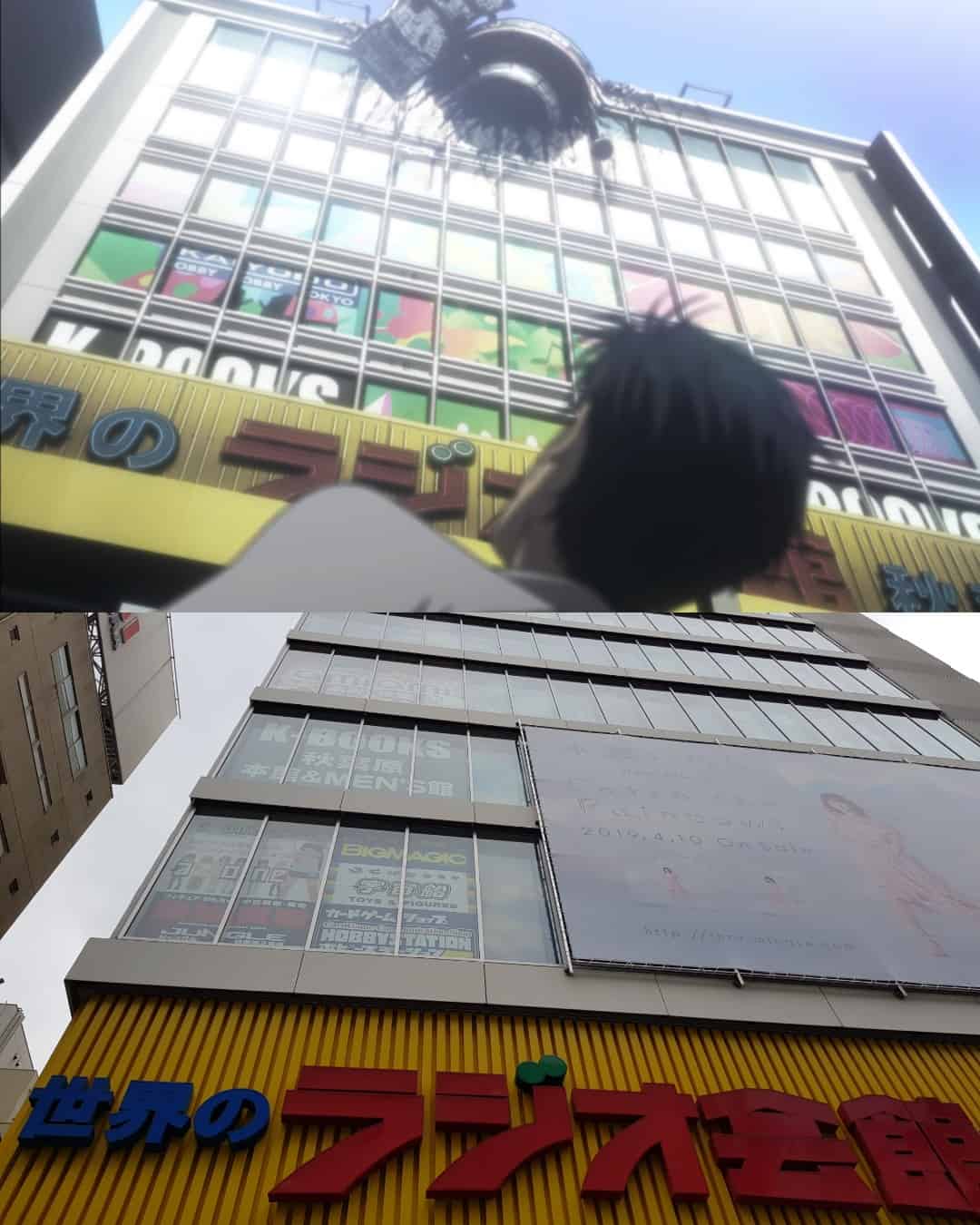
We’ve all heard about Akihabara at some point in our otaku lives, and we all know it’s an anime fan’s dream. But Radio Kaikan is also known as a store where you can buy anime figurines and merchandise. For a few weeks after Steins Gate was released, they conducted a campaign that simulated a time machine crashing on top of the structure. That is one clever marketing ploy. It’s worth looking out the building and doing some window shopping if you enjoy Steins Gate and would go otaku shopping anyway.
Also Read: Anime Similar to Takt Op. Destiny That You Should Watch
7. Demon Slayer – Asakusa, Tokyo
Asakusa is a vast, densely populated city with tall buildings and dazzling lights that light up the city at night. A large number of people pass through packed markets with dozens of business signage. Unlike Tanjiro’s little town, vehicles and carriages guide inhabitants around the streets. In addition, there is a trolley system that travels throughout the city. The city is built on a bay that is surrounded by a vast body of water and is adorned with a massive fountain tower. Tanjiro travels to Asakusa, Tokyo, for his second assignment with the Demon Slayer Corps in the anime. Tokyo, the great metropolis, is unfamiliar to the rural kid.
Welcome to the bustling Asakusa district in Tokyo! 🏮#DemonSlayer #Toonami pic.twitter.com/cOMFSICH6W
— Toonami Faithful (@ToonamiNews) December 6, 2020
Tanjiro first encountered Muzan Kibutsuji in the bustling streets of Asakusa, which is home to numerous temples and traditional festivals. For travelers from all over the globe, the region has a lot to offer. Even if you’re not a die-hard Demon Slayer fan, you may still appreciate the surrounding area’s traditional Japanese culture. Highlights include Kaminarimon, with its very enormous red lighting, the Tokyo Sky Tree, and Hanayashiki, one of Japan’s oldest amusement parks. Tanjiro travels to Tokyo’s Asakusa district for his second assignment with the Demon Slayer Corps. Tokyo, the great metropolis, is unfamiliar to the rural kid.
8. Shirakawago (Gifu)- Higurashi no Naku Koro ni
Shirakawago, a lovely town in Japan, has been more popular with travelers in recent years. Fans of Higurashi no Naku Koro ni, also known as Higurashi when they cry, have recognized Shirakawago as the real-life foundation for Hinamizawa, the town where this horror/murder mystery genre is situated, since the early 2000s.
Shirakawago, a UNESCO World Heritage site, is a lovely, rural town, so claims that some people were dissatisfied with their birthplace serving as the setting for a brutal, unsettling movie are perfectly conceivable. Still, Shirakawago’s image has definitely not suffered as a result, and the town has even staged a minimum of one tie-in campaign to promote the games.
GIFU SHIRAKAWAGO HIGURASHI
&
TOYAMA https://t.co/xtW7y247wY pic.twitter.com/ptn0irsbek— 中野土 (@nakanotti0729) June 25, 2017
Shirakawago is definitely worth a day trip from Nagoya, Kanazawa, or Takayama (which are about an hour away by bus!). Stroll through this little hamlet, seeing as many iconic Higurashi landmarks as you can: Shirakawa Hachiman Shrine (also known as the Furude Shrine in the anime), the Wada House, Miboro Dam, and more.
Hinamizawa is a fictitious town that serves as the setting for the Higurashi no Naku Koro ni series. The town is well-known for harboring the strange imaginary sickness known as the Hinamizawa Syndrome. During the Meiji period, the village’s name was changed from “Onigafuchi” to “Hinamizawa.” The name “Onigafuchi Swamp” means “abyss of devils” in Japanese. Hinamizawa’s kanji literally means “swamp,” which presumably reflects Hinamizawa’s link to the Onigafuchi Swamp.
9. Anohana – Chichibu Bridge, Chichibu City
This is a well-known real-life anime spot where you can snap photographs while overlooking the Arakawa River. I selected Chichibu Bridge because it is a one-of-a-kind and unforgettable location for me. The anime adds depth to the backdrop of the trees, making it a highly noticeable scene. You can’t miss the sacred regions of Ano Hana if you’re traveling around Tokyo. Chichibu City, on the outskirts of Tokyo, serves as the setting for the series.
Someday, after the pandemic, I want to visit Japan especially Chichibu so I can sob at the bridge from Anohana. pic.twitter.com/74Y64Ay7Qf
— 𝑇𝑎𝑦𝑙𝑜𝑟 👻📷 (@wind_tempos) April 15, 2021
This location appears multiple times in both the main portion and the opener. It is a popular stop on the “Anohana” pilgrimage. If you appreciate “Anohana,” you should visit Chichibu Bridge at least once. As Menma, you should not be on the fence! The filming took place on a historic Chichibu Bridge (second generation). The Chichibu bridge of the third generation is seen in the background.
10. One Punch Man – Saitama’s apartment, Setagaya
One-Punch Man is one of those anime that sticks out for both the simplicity of its protagonist and its tremendous combat sequences. Most mortals can relate to Saitama’s apartment until bizarre alien-looking animals materialize in front of the building. The apartment provides an excellent location for photographing this superhero’s home. Visit Z City—that is, Setagaya, Tokyo—and see Saitama’s residence nearly precisely as it appears in the anime. There’s also a roadway in front of it where Saitama “battled” the subterranean in his dream.
サイタマのアパート!I visited Saitama’s apartment from One Punch Man!!#ワンパンマン #OnePunchMan #サイタマ #Saitama pic.twitter.com/rSFrPA7PqM
— monkey 𓃷 (@Yanappuu) November 4, 2019
According to legend, the strongest hero, King, would sometimes visit here. He does not sign autographs. The structure that served as the inspiration for the anime is still standing. It lies in the Setagaya area of Tokyo, near Meiji University. If you’re in Tokyo and a fan of One Punch Man, you should pay this establishment a visit. The nearest station is Meidaimae Station. The station is just a 6-minute rail ride from Shinjuku and a 7-minute walk from Shibuya.
It takes around 7 minutes to walk from Meidaimae Station to Saitama’s building. If you aren’t a fan, there are other spots in Tokyo that have been in other notable anime, like the real-life locales of Steins; Gate or the renowned red steps in Your Name (Kimi No Ha).
Saitama’s flat is in an area named ‘Z-city’ in the anime. This city is seen on a map in the anime and is situated in the upper left corner of the nation where Saitama lives. As a result, many Japanese fans first assumed that the apartment was in the ‘Saitama’ district due to two factors. First, the neighborhood has the same name as the protagonist. Therefore it stands to reason that he resides there, and second, the neighborhood of Saitama is situated in Tokyo’s upper left corner.
Also Read: 10 Anime Arcs That Were Taken Negatively By Fans